Art & Museums Extended (3 hours)
Highlights
- Marvel at the imperial collections of the Kunsthistorisches Museum
- Discover cutting-edge contemporary art at MuseumsQuartier
- See Klimt and Schiele at the Albertina
- Visit the Secession building, icon of the Vienna art movement
Stop by stop
Kunsthistorisches Museum
One of the world's most important art history museums, built for Emperor Franz Joseph I.
Maria-Theresien-Platz
Twin world-class museums face each other across this majestic square.
MuseumsQuartier
One of the largest cultural districts in the world, spanning baroque to contemporary.
Albertina
One of the world's greatest graphic art collections, housed in a Habsburg palace.

Secession
The iconic golden 'cabbage' building, home of the Vienna Secession art movement since 1897.
Overview
Vienna is one of the great art cities of the world — not merely as a repository of historic masterpieces, but as the birthplace of one of art history's most radical and consequential movements. At the turn of the 20th century, a group of artists led by Gustav Klimt broke from the conservative Viennese art establishment to form the Secession: a movement that would influence everything from fine art and architecture to graphic design and cinema across the following century.
This three-hour walk takes you through the full arc of Vienna's artistic legacy — from the imperial collections of the Kunsthistorisches Museum, through the vast creative campus of the MuseumsQuartier, to the Albertina's world-class collection and the Secession building itself. You will not have time to explore every museum in depth on a single walk; instead, this route is designed to orient you — to show you where everything is and what makes each place singular, so that you can return for longer visits with full clarity of purpose.
Allow three comfortable hours. Wear shoes you can stand in. And consider building in an extra hour at whichever stop captivates you most.
Stop by Stop
Kunsthistorisches Museum
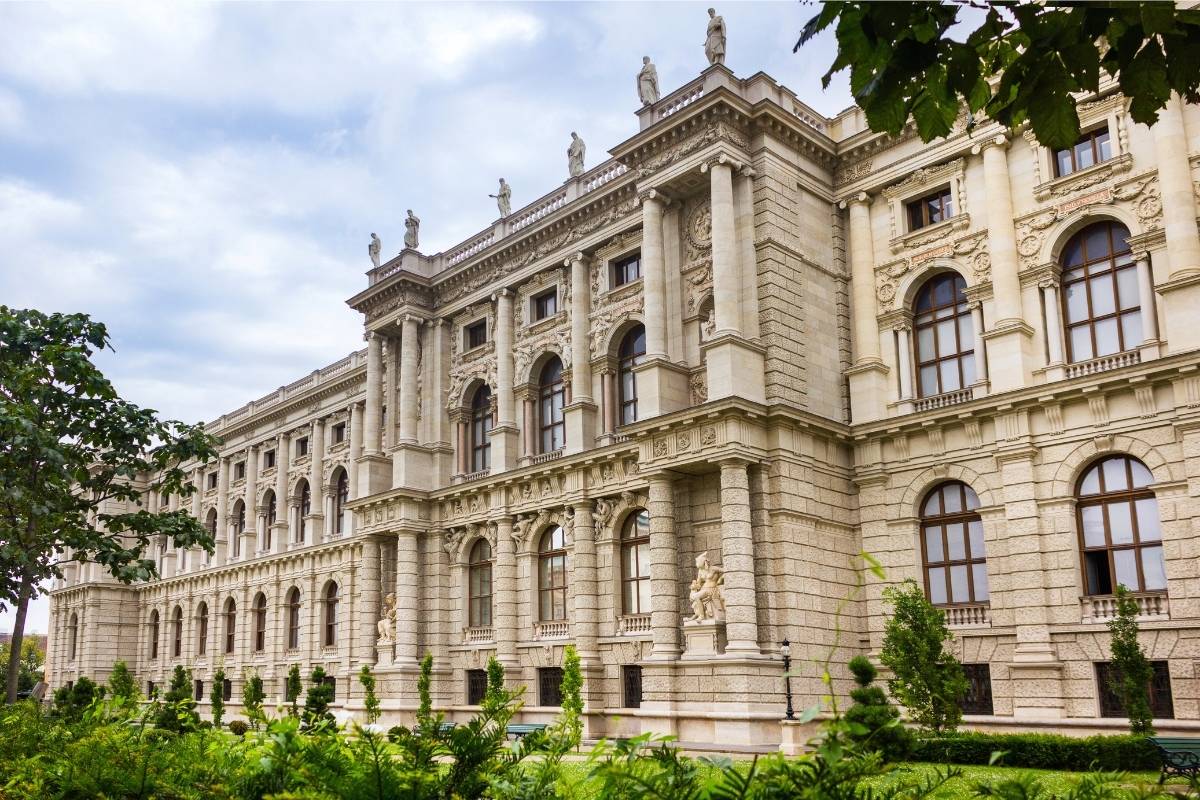
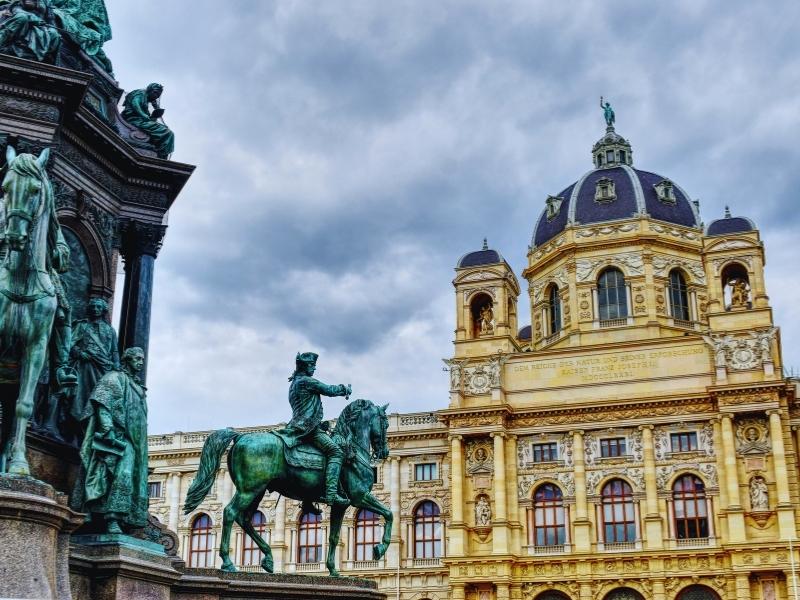
The Kunsthistorisches Museum — the Museum of Art History — is one of the most important art museums in the world and arguably the finest building on the Ringstraße. It was conceived by Emperor Franz Joseph I as a monument to Habsburg cultural achievement, built between 1872 and 1891 by Gottfried Semper and Carl von Hasenauer, and opened with a collection assembled over five centuries of imperial patronage.
The building itself is extraordinary before you see a single painting: a neo-Renaissance palace with a domed octagon at its centre, its interior decorated with marble, stucco, and ceiling paintings by Hans Makart. The grand staircase, flanked by seated figures and topped with a lunette painted by the young Gustav Klimt, is one of the most photographed museum interiors in Europe.
The collection spans Ancient Egyptian and Near Eastern Art, Greek and Roman Antiquities, a Coin Cabinet, and the Picture Gallery — which holds works by Vermeer, Raphael, Caravaggio, Rembrandt, Titian, and one of the world's most important collections of Pieter Bruegel the Elder. Allow at least two hours if you go inside; the Egyptian collection alone warrants an hour.
Insider tip: The museum café, under the central dome and surrounded by balconies, is one of the most beautiful dining rooms in any museum anywhere. Even a coffee here is an experience.
Maria-Theresien-Platz
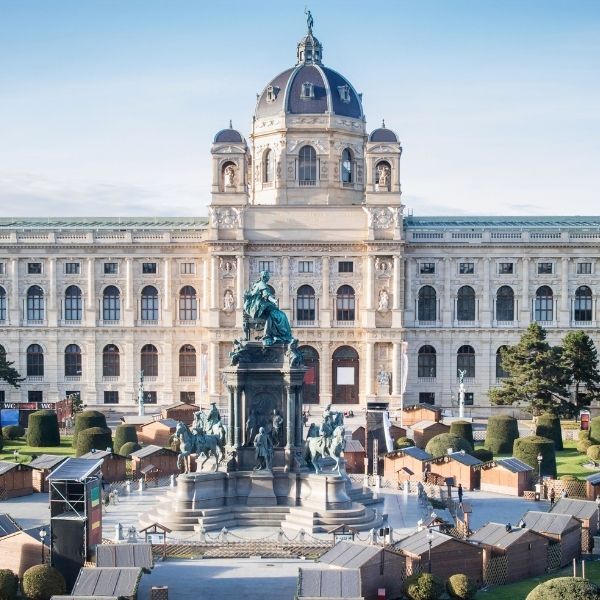
Step outside the Kunsthistorisches Museum and you are on Maria-Theresien-Platz — the symmetrical square that separates it from its twin, the Naturhistorisches Museum (Museum of Natural History). Both buildings are deliberately identical in their external form, an exercise in Historicist grandeur that creates one of Vienna's most satisfying urban compositions.
At the centre stands the monument to Empress Maria Theresa (1717–1780): an immense bronze figure enthroned above an ensemble of her most important generals, statesmen, and artistic patrons. She is depicted holding the Pragmatic Sanction — the document by which she secured her right to rule — and looks south with the quiet authority of someone who has seen off a great deal of opposition.
The square is a natural gathering point, often animated by street performers, summer film screenings (as part of the Filmfestival Wien), and winter markets. It is also simply a pleasure to stand in and look at — the kind of urban planning that takes your breath away when you realise it has been here for 150 years.
MuseumsQuartier
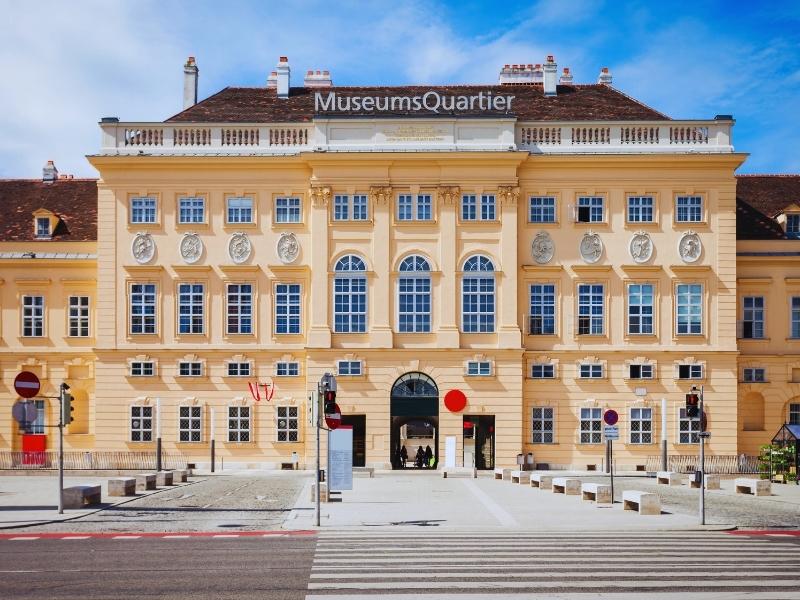
Through a gate on the west side of Maria-Theresien-Platz, the MuseumsQuartier (MQ) occupies the former Imperial Court Stables — baroque buildings that once housed over 600 horses, repurposed in 2001 into one of the largest cultural districts in the world. The contrast between the 18th-century façade on the Ringstraße and the contemporary architecture within is intentional and striking.
The MQ is home to MUMOK (Museum of Modern Art Ludwig Foundation Vienna), the Leopold Museum (with the world's largest Egon Schiele collection), the Kunsthalle Wien, multiple theatre and performance spaces, architecture and design centres, and a handful of excellent independent cafés and restaurants. In summer, the central courtyard becomes one of Vienna's best outdoor gathering spots, filled with colourful reclinable benches known as "enzis."
For the purposes of this walk, explore the courtyard and façades without going inside — but note the buildings for future dedicated visits. The Leopold Museum's Schiele collection and MUMOK's 20th-century holdings each deserve half a day.
Albertina
Return east along the Burggasse and Mariahilfer Straße to reach the Albertina — a Habsburg palace perched on the last surviving section of the city's baroque fortification wall, above the Burggarten. The Albertina holds one of the most important graphic art collections in existence: over a million prints and drawings including Dürer's Young Hare, works by Leonardo da Vinci, Michelangelo, Raphael, and an outstanding modern collection spanning Monet, Cézanne, Klimt, Schiele, Matisse, Picasso, and Baselitz.
The Albertina also hosts major temporary exhibitions — historically at the forefront of Vienna's blockbuster show schedule. Check what is on before your visit; the temporary shows often rival the permanent collection in scale and quality.
The terrace outside the museum, overlooking the Burggarten with the Staatsoper visible to the right, is one of Vienna's finest free viewpoints. The equestrian statue of Archduke Albert surveys the city with the quiet confidence of a man who won the Battle of Custoza against all odds in 1866.
Secession
End the walk at one of the most radical buildings in Vienna — and one of the most radical statements in European architectural history. The Secession building, designed by Joseph Maria Olbrich and completed in 1898, was built as the exhibition hall for the Vienna Secession — the group of artists led by Gustav Klimt who broke from the conservative Künstlerhaus establishment in 1897 to pursue a new, total vision of art.
The building's dome — a golden sphere of 3,000 gilded laurel leaves that Viennese locals affectionately call the "golden cabbage" — is visible from half a mile away on a clear day. Above the entrance, three gilded owls flank the relief inscription: Der Zeit ihre Kunst. Der Kunst ihre Freiheit. — "To every age its art. To art its freedom." It remains one of the most definitive statements of artistic purpose ever carved in stone.
Inside, in the basement, is the only permanent work ever installed in the building: Klimt's Beethoven Frieze, a 34-metre-long allegorical painting created for the 1902 Secession exhibition and widely regarded as one of the masterworks of Symbolist art. Admission to the building is €10.
Insider tip: The Naschmarkt, Vienna's largest open-air market, begins just across the Linke Wienzeile from the Secession — ideal if you want to end the tour with food and browsing rather than a museum.
Practical Tips
- Best time to walk: Weekday mornings are quietest at both the KHM and Albertina. The MQ courtyard is most animated in the afternoon.
- Entry costs: KHM €21; Albertina €18.50; Secession (Beethoven Frieze) €10; MUMOK €15; Leopold Museum €18. Budget accordingly — you will not visit all of them in a single day.
- What to wear: Comfortable shoes for standing; the KHM in particular involves a great deal of time on marble floors.
- Duration: Allow an extra 30–60 minutes at whichever museum draws you in deepest.
- Getting there: U2 Museumsquartier drops you between the KHM and the MQ entrance. U1/U2/U4 Karlsplatz is closest for the Secession.